How to Understand Assignment Instructions Before You Start Writing
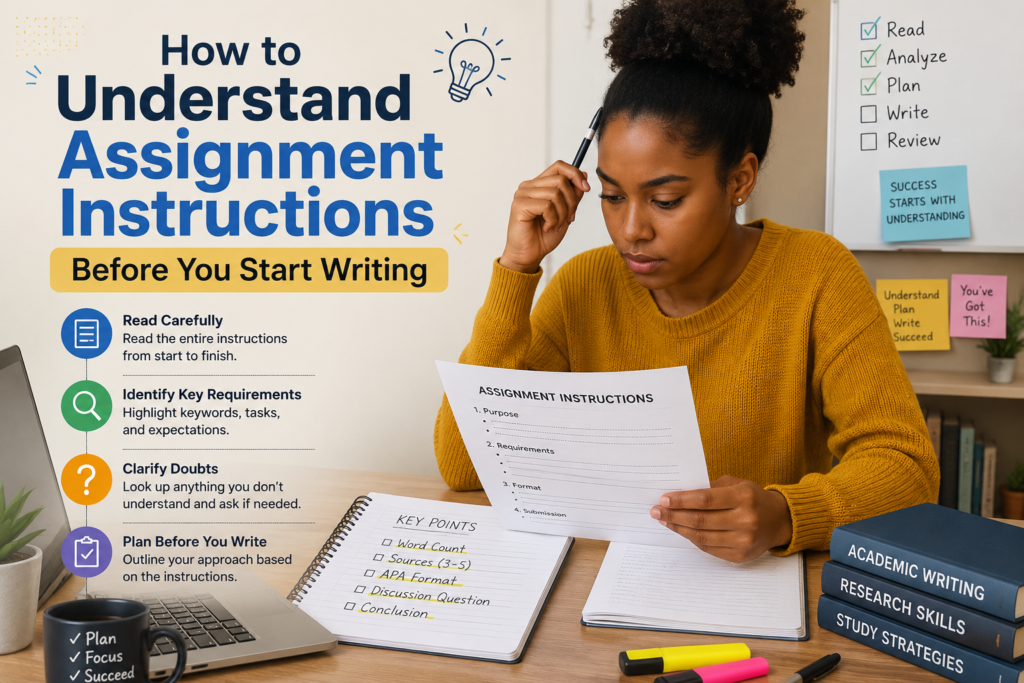
One of the most common reasons students lose points on an assignment has nothing to do with grammar, research, or writing skills. It comes down to simply misunderstanding what was actually asked. A well-written paper that answers the wrong question can still earn a low grade, while a rougher paper that hits every requirement often scores better. Before you write a single sentence, it pays to slow down and make sure you truly understand the assignment.
Why Students Misread Instructions So Often
Assignment prompts are often written quickly by instructors who assume certain things are obvious. Students, on the other hand, are usually skimming multiple assignments across several classes and may miss key details buried in a paragraph of instructions. A few common reasons instructions get misread include:
- Skimming instead of reading closely, especially near a deadline
- Assuming a prompt is similar to a past assignment when it’s actually different
- Focusing only on the topic and missing formatting or structural requirements
- Overlooking a rubric that’s attached separately from the main prompt
Recognizing these patterns in your own habits is the first step toward avoiding them.
Step 1: Read the Instructions More Than Once
The first read through of an assignment should just be to get a general sense of what’s being asked. Resist the urge to start planning your paper immediately. On a second read, slow down and look specifically for:
- The core question or task you’re being asked to complete
- Any sub questions or multiple parts hidden within the prompt
- Specific requirements around length, format, or sources
A third pass, ideally after a short break, often catches details that were missed the first two times. Instructions read right before a deadline are far more likely to be misunderstood than instructions read a day or two ahead of time.
Step 2: Identify the Task Verbs
Assignment prompts almost always contain verbs that tell you exactly what kind of thinking is expected. Missing these words is one of the most common reasons students answer the wrong type of question. Some common examples include:
- Analyze – break something down into parts and examine how they relate
- Compare or contrast – identify similarities and differences between two or more things
- Evaluate – make a judgment supported by evidence, not just describe
- Summarize – condense the main points without adding personal opinion
- Argue or defend – take a clear position and support it with evidence
Circling or highlighting these verbs as you read helps ensure your paper actually does what’s being asked, rather than simply describing a topic when analysis was expected.
Step 3: Break the Prompt Into a Checklist
Many assignments contain multiple requirements packed into a single paragraph. Turning the prompt into a simple checklist makes it far easier to track everything and confirm nothing gets missed. A checklist might include items like:
- Required length or word count
- Number and type of sources needed
- Specific formatting style, such as APA or MLA
- Whether a particular structure is required, like an introduction, body, and conclusion
- Any specific questions that must be addressed individually
Referring back to this checklist while writing, and again before submitting, catches missing pieces before they cost you points.
Step 4: Check for a Rubric
Many instructors post a grading rubric separately from the main assignment description, and it’s easy to miss if you’re only looking at the written prompt. A rubric often reveals exactly how points are distributed, which tells you where to focus your effort. If a rubric shows that argument strength is worth far more than formatting, for example, that should shape how you spend your time while writing.
If no rubric is provided, it’s reasonable to ask your instructor how the assignment will be graded, which often reveals expectations that aren’t obvious from the prompt alone.
Step 5: Look for Implicit Expectations
Not every requirement is stated directly. Some expectations are implied by the course itself or by common academic conventions. Consider:
- What has the class focused on recently that this assignment likely connects to?
- Does the course generally expect a formal academic tone, or is a more personal voice acceptable?
- Are there examples from class discussions or lectures that hint at what the instructor is looking for?
Reviewing recent class notes or discussion topics before starting can reveal expectations that never appear directly in the written prompt.
Step 6: Ask Questions Before You Start Writing
If anything in the instructions feels unclear after going through these steps, ask before writing rather than guessing and hoping for the best. A short, specific question to your instructor or teaching assistant can save hours of wasted effort. Effective questions are specific rather than vague, such as:
- “Should this paper focus more on summarizing the research or evaluating it?”
- “Does the required word count include the reference list?”
- “Are we expected to use outside sources beyond the assigned readings?”
Most instructors would rather answer a clarifying question early than grade a paper that missed the point entirely.
Step 7: Restate the Assignment in Your Own Words
A useful final check is to write a summary of the assignment in your own words before you begin drafting. Something like, “This assignment wants me to compare two theories, take a position on which is stronger, and support that with at least four sources.” If you can’t summarize the task clearly and confidently, that’s a sign you need to reread the instructions or ask for clarification before moving forward.