How to Master APA Citations and Make Academic Writing Effortless
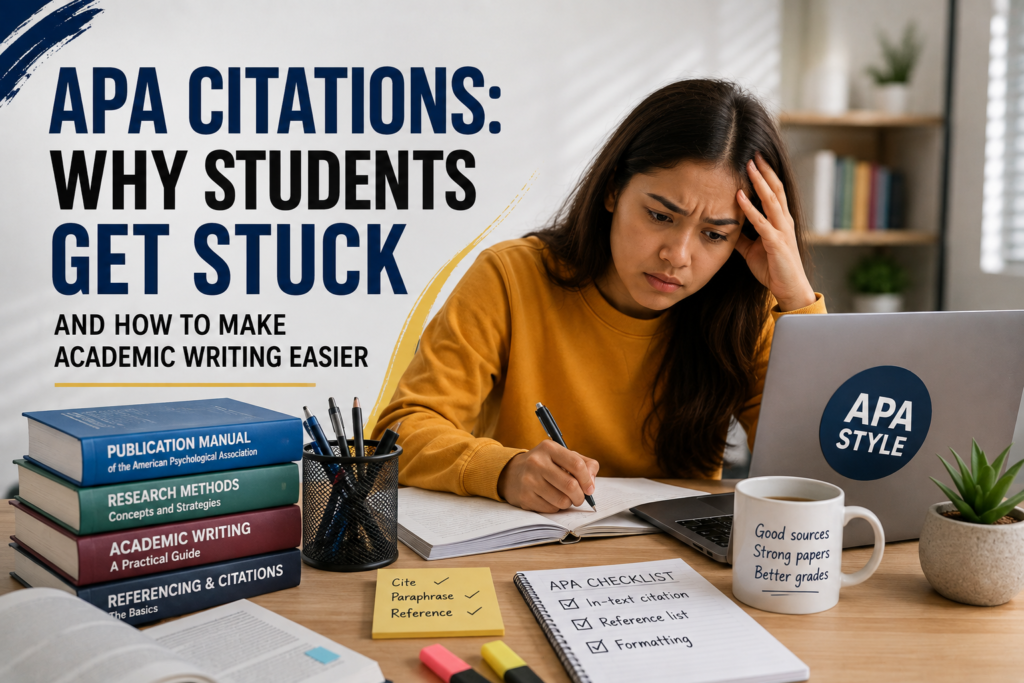
APA citations are a common challenge for college and university students. Additionally, they may understand the topic, conduct research, and write well, yet misplace references.
For many students, the problem is not simply knowing that sources must be cited. The real challenge is understanding when to cite, what information to include, how to format in-text citations, and how to match those citations with the reference list.
Why APA Citations Can Be Confusing
APA Style has specific rules that students must follow. Depending on the source, a citation may require the author’s name, publication year, page number, title, journal name, volume, issue, publisher, or DOI.
Students often get stuck because different sources require slightly different reference formats. For example, citing a journal article is not the same as citing a book, website, government report, or online source.
A student may also struggle with questions such as:
- When should I use a parenthetical citation?
- When should I include the author’s name in the sentence?
- Do I need a page number?
- What happens when a source has multiple authors?
- How do I cite a website with no author?
- How do I create the correct reference list entry?
These small details can quickly become frustrating, especially when a student is already dealing with multiple assignments and deadlines.
The Difference Between In-Text Citations and References
One common mistake is confusing an in-text citation with a reference.
An in-text citation appears within the body of the paper and shows the reader where a particular idea, fact, or quotation came from. For example:
Academic stress can affect students’ motivation and performance (Smith, 2024).
The reference list provides the full publication details so the reader can identify and locate the original source.
For example:
Smith, J. A. (2024). Student motivation in higher education. Academic Press.
The basic rule is simple: sources cited in the paper should generally appear in the reference list, and sources in the reference list should be connected to the work being discussed or cited in the paper.
Why Students Get Stuck With APA Citations
They Are Unsure When APA Citations Are Necessary
Students sometimes believe citations are only needed when directly quoting an author. However, citations are also generally needed when using another author’s ideas, findings, arguments, statistics, or information that is not common knowledge.
Paraphrasing does not eliminate the need for citation. Changing the wording of an author’s idea without identifying the source can still create academic integrity problems.
2. Paraphrasing Can Be Difficult
A common challenge is finding the balance between accurately representing the original source and writing the information in the student’s own words.
Some students change only a few words from the original sentence. Others accidentally change the meaning of the author’s argument. Effective paraphrasing requires understanding the original idea first and then explaining it independently while still providing an appropriate citation.
3. Multiple Authors Create Confusion
APA citation rules change depending on the number of authors. Students may also struggle when citing organizational authors, government agencies, or sources without a clearly identified individual author.
Without understanding these rules, it is easy to create inconsistent citations throughout a paper.
4. Online Sources Are Not Always Straightforward
Students frequently use online articles, reports, databases, and websites. However, not every website provides clear information about the author, publication date, or organization responsible for the content.
This can leave students wondering how to create an accurate citation without missing important details.
5. The Reference List Does Not Match the Paper
Another common problem occurs when a student adds sources to the reference list that were never cited in the paper or cites a source in the paper but forgets to include it in the references.
This often happens when students work under pressure or add sources while editing their assignments.
Common APA Citation Mistakes
Some of the most frequent APA citation problems include:
- Missing citations after paraphrased information.
- Incorrect author names or publication dates.
- Using quotation marks without including the appropriate source information.
- Incorrect formatting of multiple-author citations.
- Missing or incorrect DOI information when available.
- Inconsistent capitalization in reference titles.
- Including sources in the reference list that do not appear in the paper.
- Forgetting to include cited sources in the reference list.
- Copying references directly from unreliable citation generators without checking them.
Even a well-written paper can look less professional when citations and references are inconsistent.
How Students Can Avoid Getting Stuck
The best approach is to deal with citations while writing instead of waiting until the entire paper is finished.
When taking notes from a source, students should record the important publication details immediately. This includes the author, date, title, publication information, and source location.
Students should also keep track of which ideas came from which sources. This makes it much easier to add accurate citations later and reduces the risk of accidentally presenting someone else’s work as their own.
Before submitting an assignment, it is helpful to complete a final citation check:
- Review every quotation and paraphrased idea.
- Confirm that appropriate in-text citations are included.
- Check that each cited source appears in the reference list.
- Review the reference list for consistency.
- Make sure the paper follows the APA edition required by the instructor or institution.
Academic Writing Should Not Become a Citation Nightmare
APA formatting can feel overwhelming, particularly for students managing several courses, assignments, research papers, discussions, and deadlines at the same time. However, citation problems become easier to manage when students understand the difference between quoting, paraphrasing, citing, and referencing.
The goal is not simply to add citations to a paper. Good citation practices help students show where information came from, support their arguments with credible research, and demonstrate academic integrity.
When students get stuck, taking the time to check the source details and understand the citation requirements can prevent last-minute formatting problems. With practice, APA citations become less intimidating and become a natural part of the academic writing process.
Need Help Understanding APA and Academic Writing?
If you are struggling with APA citations, references, paraphrasing, research, or the overall structure of an academic paper, getting guidance can make the process much easier. Understanding how to properly support your ideas with credible sources is an important academic skill that can improve the quality and professionalism of your work.
Whether you are working on an essay, research paper, assignment, or discussion post, careful attention to citations can help you avoid unnecessary mistakes and submit work with greater confidence.