How to Write Strong Research Questions for Your Master’s Paper
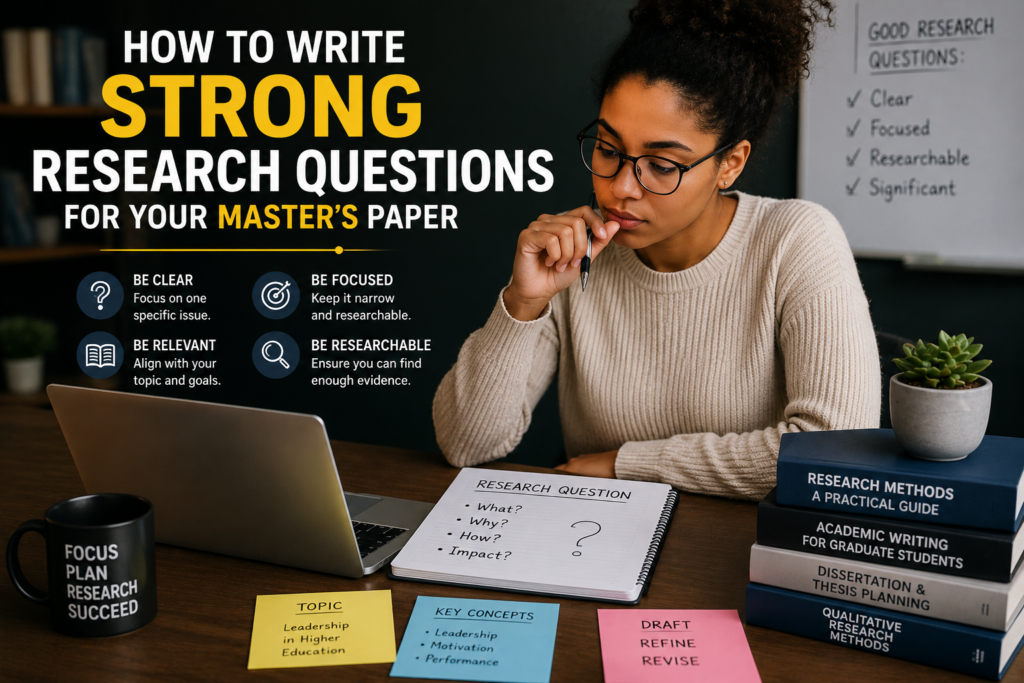
The research question is the backbone of any master’s paper. Everything else, your literature review, your methodology, your analysis, exists to answer it. Yet many graduate students spend weeks on a topic before realizing their question is too broad, too vague, or impossible to actually answer with the time and resources they have. Getting this step right early on saves enormous amounts of time later.
Why the Research Question Matters So Much
A weak research question causes problems that ripple through the entire paper. If it’s too broad, you’ll drown in sources and never narrow your focus. If it’s too narrow, you may struggle to find enough evidence to support a full-length paper. If it’s poorly worded, your advisor and committee may struggle to see what you’re actually trying to accomplish.
A strong research question does the opposite. It gives your paper direction, helps you decide what to include and what to leave out, and makes the entire writing process faster because you always know what you’re working toward.
Start With a Broad Area of Interest
Before you can write a specific question, you need a general area you’re genuinely curious about. This might come from:
- A topic covered in one of the courses that you wanted to explore further
- A gap or unanswered question you noticed while reading the assigned research
- A real-world problem connected to your field or career
Write down two or three broad areas that interest you before narrowing anything down. Trying to jump straight to a specific question without this step often leads to picking a topic that sounds impressive but doesn’t actually interest you enough to sustain months of work.
Narrow Your Topic With Specific Angles
Once you have a general area, start narrowing it using a few key angles:
- Population – who or what are you studying? A specific age group, industry, region, or organization type?
- Variable or relationship – what specific factor, behavior, or outcome are you interested in?
- Context – is there a particular setting, time period, or condition that matters?
For example, “employee motivation” is far too broad on its own. Narrowing it by population, context, and variable might turn it into something like, “How does remote work affect motivation among early career employees in the technology industry?”
Apply the FINER Criteria
A widely used framework for evaluating research questions is FINER, which stands for feasible, interesting, novel, ethical, and relevant. Running your draft question through these five checks helps catch problems early.
- Feasible – can you realistically collect the data or sources needed within your program’s timeline and resources?
- Interesting – does the question genuinely engage you and your intended audience, not just sound impressive?
- Novel – does it add something new, even in a small way, rather than repeating existing research?
- Ethical – can the question be studied without causing harm or violating research ethics standards?
- Relevant – does it matter to your field, your program, or a real-world audience?
If your question fails on any of these points, it’s worth revising before moving forward.
Make Sure the Question Is Actually Answerable
A common mistake is writing a question so broad or abstract that no single paper could realistically answer it. Questions like “What is the meaning of success in education?” sound thoughtful but are nearly impossible to research in a focused way.
Instead, aim for a question that’s specific enough to guide real data collection or analysis. A strong version might be something like, “What factors most influence graduation rates among first-generation college students at mid-sized public universities?”
A helpful test is to ask yourself, “If I found the answer to this question, would it be a clear, specific finding, or just another vague generalization?”
Choose the Right Type of Question for Your Method
The structure of your research question often depends on the kind of study you’re planning.
- Descriptive questions ask what is happening, such as “What strategies do nurses use to manage burnout?”
- Comparative questions ask how two or more things differ, such as “How do online and in-person students compare in course completion rates?”
- Relational or causal questions ask how one factor affects another, such as “How does parental involvement affect reading skills in early elementary students?”
Matching your question type to your intended methodology, whether qualitative, quantitative, or mixed methods, keeps your entire paper consistent from the start.
Avoid Common Research Question Mistakes
A few patterns show up again and again in weak research questions:
- Asking a yes or no question instead of one that requires real analysis
- Including two separate questions joined together, which splits your focus
- Using vague terms like “impact” or “effectiveness” without defining what you’re actually measuring
- Choosing a topic so broad that an entire book, not a single paper, would be needed to answer it
Reading your draft question out loud and asking, “Could someone else clearly understand exactly what I’m trying to find out,” is a simple way to catch these issues.
Get Feedback Early
Once you have a draft question, share it with your advisor or a trusted classmate before committing to it fully. A second set of eyes often catches problems you can’t see after staring at your own topic for weeks. Ask specific questions when getting feedback, such as:
- Does this seem feasible given my timeline and access to data?
- Is this too broad or too narrow for a master ‘s-level paper?
- Does the wording clearly convey what I’m trying to study?
Expect to Revise Your Question
Even strong research questions usually go through several drafts. As you read more literature and begin early research, you may discover your original question needs to shift slightly, whether because the data available doesn’t match what you hoped, or because your reading reveals a more interesting angle. This is a normal part of the process, not a sign you did something wrong at the start.