What Is APA Format and How Do You Use It?
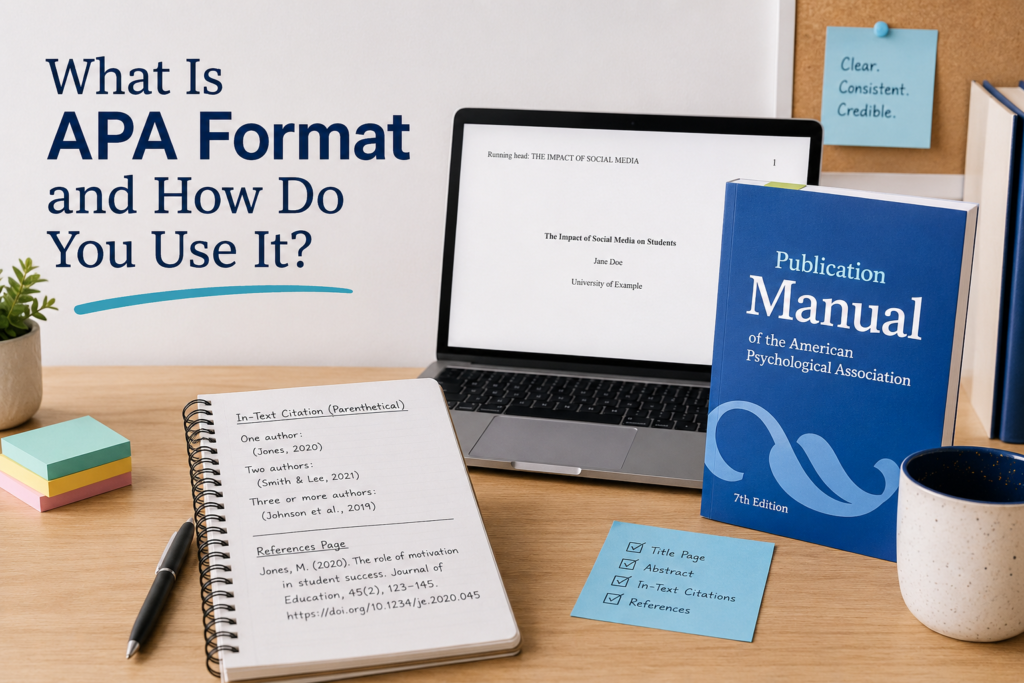
If you are studying psychology, nursing, education, business, or any social science discipline, chances are your professor has asked you to write in APA format. For many students, those three letters trigger instant anxiety. Is the title page right? Are the headings correct? What about the reference list?
This guide breaks down everything you need to know about APA format, from page setup to in-text citations to the reference list, so you can write with confidence and avoid losing marks on formatting alone.
What Is APA Format?
APA stands for the American Psychological Association. APA format is a citation and formatting style used primarily in the social sciences, including psychology, sociology, education, nursing, business, and criminal justice. The current standard is the 7th edition of the APA Publication Manual, which is what most universities require today.
APA format is used for:
- Research papers and literature reviews
- Case studies and clinical reports
- Discussion posts in online psychology, nursing, and business courses
- Capstone projects and dissertations
- Annotated bibliographies
APA Paper Formatting Basics
Before you even think about citations, your paper needs to follow specific formatting rules.
Font: Times New Roman 12pt, Arial 11pt, or Calibri 11pt are all acceptable. Check your professor’s preference if unsure.
Spacing: Double-spaced throughout the entire paper, including the reference list.
Margins: One inch on all sides.
Page numbers: Located in the top right corner of every page, including the title page.
Title page: APA 7 has two formats, student papers and professional papers. For most college assignments, you will use the student version, which includes the paper title, your name, your university, the course name and number, your instructor’s name, and the due date, all centered on the page.
Running head: Student papers in APA 7 do not require a running head, unlike older APA editions. Professional papers do require one. Always check your assignment instructions to confirm which version applies.
APA In-Text Citations
APA in-text citations use the author-date format. This means every time you reference a source, you include the author’s last name and the year of publication.
Basic Format:
(Author Last Name, Year)
Examples:
Paraphrase:
Cognitive behavioral therapy has shown strong effectiveness in treating anxiety disorders (Smith, 2020).
Direct quote (under 40 words):
According to Smith, “cognitive behavioral therapy remains one of the most evidence-based treatments available” (2020, p. 45).
Two authors:
Both depression and anxiety are commonly treated using a combination of therapy and medication (Johnson & Lee, 2019).
Three or more authors:
Recent studies confirm a strong link between sleep quality and academic performance (Garcia et al., 2021).
No author:
Online learning has grown rapidly across higher education institutions (“Summer Enrollment Trends,” 2023).
Key Rules for In-Text Citations:
- Use an ampersand (&) inside parentheses, but the word “and” when the citation is part of the sentence
- For three or more authors, use “et al.” after the first author’s name
- Include the page number for direct quotes using “p.” before the number
- Place the citation before the final punctuation mark of the sentence
APA Reference Page Formatting
The reference page is placed at the end of your paper on a new page. It lists every source cited in your paper in alphabetical order by the author’s last name.
Page Formatting:
- Title: References, centered and bolded at the top
- Double-spaced throughout
- Hanging indent for each entry, with the second line indented 0.5 inches
- Same font and size as the rest of your paper
APA Reference Examples by Source Type
1. Journal Article
Format: Author, A. A. (Year). Title of article. Journal Name, Volume(Issue), page range. https://doi.org/xxxx
Example: Williams, A. (2021). The effects of accelerated learning on student performance. Journal of Higher Education, 58(3), 112-130. https://doi.org/10.1234/jhe.2021.0345
2. Book
Format: Author, A. A. (Year). Title of book. Publisher.
Example: Smith, J. (2020). The rise of online education. Academic Press.
3. Website or Online Article
Format: Author, A. A. (Year, Month Day). Title of page. Website Name. URL
Example: Garcia, L. (2023, May 15). How to succeed in online summer courses. Education Today. https://www.educationtoday.com/online-summer-courses
4. Article with No Author
Format: Title of article. (Year, Month Day). Website Name. URL
Example: Summer enrollment trends rise sharply. (2023, June 10). Education Weekly. https://www.educationweekly.com/summer-enrollment
5. Chapter in an Edited Book
Format: Author, A. A. (Year). Title of chapter. In E. Editor (Ed.), Title of book (pp. xx-xx). Publisher.
Example: Johnson, M. (2019). Understanding student motivation. In R. Brown (Ed.), Educational psychology today (pp. 45-67). Pearson.
6. Government or Organization Report
Format: Organization Name. (Year). Title of report. URL
Example: American Psychological Association. (2023). Stress in America report. https://www.apa.org/stress-report
Common APA Mistakes to Avoid
1. Confusing APA with MLA
APA uses author-date citations like (Smith, 2020), while MLA uses author-page like (Smith 45). Mixing the two formats is one of the most common errors students make.
2. Forgetting the DOI or URL
Whenever a DOI is available for a journal article, include it. If no DOI exists, include the URL instead.
3. Incorrect Capitalization in Titles
APA uses sentence case for article and book titles in the reference list, meaning only the first word and proper nouns are capitalized. Journal titles, however, use title case where most major words are capitalized.
4. Missing the Hanging Indent
Every reference entry after the first line must be indented 0.5 inches. This is one of the most frequently missed formatting rules.
5. Listing Sources Not Cited in the Paper
Every source on your reference page must be cited somewhere in your paper, and every in-text citation must have a matching reference entry.
APA Format for Summer Class Assignments
If you are taking online summer classes in nursing, psychology, business, or education, APA format will almost certainly be required for your essays, case studies, and discussion posts. Summer courses move quickly, and formatting mistakes are easy to make when you are racing against tight deadlines.
Before submitting any APA paper, run through this checklist:
- Title page follows the student or professional format as required
- All in-text citations use the author-date format
- Direct quotes include a page number
- Reference page is titled “References” and appears on a new page
- All entries use a hanging indent
- Sources are listed alphabetically by author’s last name
- Every in-text citation has a matching reference entry
Need Help With Your APA Paper or Summer Assignments?
Getting APA formatting exactly right takes practice, and when you are managing multiple summer courses with assignments due every week, formatting errors can quietly drag your grade down even when your content is strong.
At AcademicWritingPro.net, our expert academic writers are fully versed in APA, MLA, Chicago, and all other major citation formats. Whether you need:
- A properly formatted APA research paper or case study written from scratch
- Help correcting and formatting your reference page
- Support with discussion posts that require APA citations
- Full online summer class assignment help across nursing, psychology, business, and education
We have you covered. Our writers deliver properly formatted, plagiarism-free academic work on time, every time, even on the tightest summer deadlines.
Do not lose marks over formatting errors. Let the professionals handle it.
Place your order today at academicwritingpro.net
Quick APA Reference Cheat Sheet
| Source Type | In-Text Citation | Reference Format |
| Journal Article | (Author, Year) | Author, A. (Year). Title. Journal, Vol(Issue), pages. DOI |
| Book | (Author, Year) | Author, A. (Year). Title. Publisher. |
| Website | (Author, Year) | Author, A. (Year, Month Day). Title. Site Name. URL |
| No Author | (Title, Year) | Title. (Year, Month Day). Site Name. URL |
| Three or More Authors | (Author et al., Year) | First Author, A., Second, B., & Third, C. (Year). Title. |